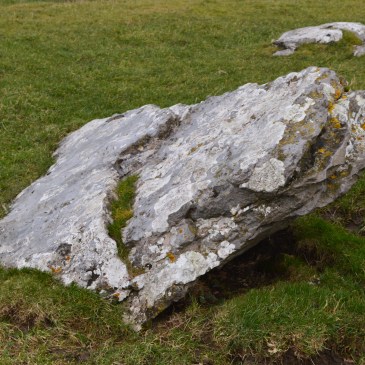
A casual look at any 1:25000 Ordnance Survey map of the Peak District will reveal a profusion of prehistoric sites – earthworks, stone circles, tumuli and so on. Combining searching these out on the ground with a long walk, a spot of photography and a visit to a good pub on the way is a particular hobby of mine. There is nothing so relaxing and so rewarding. Plus a bit of research into these sites in advance, or later when back at base.
The Peak District, together with the lowland fringes to the east, south and west, provides a rich and eloquent record of prehistoric cultures from the Old Stone age to the Iron Age. While it is true that only limited evidence is available concerning the movement of early peoples into Britain from outside, there is ample testimony to the continuity of culture and of its adaptation to changing conditions. It is in this respect that The Peak occupies a rather special position in archaeology. In contrast to the surrounding lowlands, it was penetrated only by relatively small numbers belonging to successive migrations which brought new cultures to these islands. As a result each new culture, reaching the uplands by tenuous lines of movement, was largely absorbed and modified by the existing one. To this fact must be attributed a certain lack of clear differentiation between the characteristic features of one cultural phase and the next.
In Britain and north-west Europe primitive man belonging to the Old Stone Age first appeared during a warmer interval in the Great Ice Age and gained a livelihood by hunting. Not far to the east of the Peak District, but within Derbyshire, the caves at Creswell have yielded a full and unique record of his sojourn in that part of the country. In striking contrast are the few finds belonging to that time which have been made within the Peak. These consist of a few quartzite tools from a cave at Harborough Rocks near Brassington and a flint from the Ravenscliff Cave in Cressbrook dale. A black chert hand-axe of Old Stone Age pattern, found in the gravels of the Trent, points to the early use of this material which occurs in the limestone of The Peak. These finds, however, are sufficient to indicate that Old Stone Age or Palaeolithic man at least ventured into the area.
I have visited Creswell Crags several times over the years, and always find it very rewarding. There is a definite atmosphere of serious antiquity when walking between the cliffs and caves, especially on a misty or drizzly day. It is quite possible to imagine how it all looked all those thousands of years ago.
Evidence is much more abundant for the presence of prehistoric man in post-glacial times. A good introduction to this part of the story is furnished by discoveries made in the peat cover of the moorlands, especially on Warwick Hill near Marsden. Here under a layer of peat three feet thick the surface of the gritstone is covered by an ancient sandy soil in which flint flakes have been found exhibiting the workmanship of Mesolithic or Middle Stone Age man who lived in Britain possibly from 5000 to 4000BC. These flints were found in such numbers as to suggest that man was at that time more than a mere visitor to the Peak District. Plant remains found in association with these relics shows that at even at these high altitudes birch-oak woodlands flourished and that the climate was sufficiently genial for him to live in the open air.
Fewer traces of Mesolithic man have been found on the limestone, the only implements so far discovered having come from Thor’s Cave in Dovedale and from Demon Dale near Taddington.
Towards the close of this period the climate, though still warm, became moister and consequently peat began to form on the moorlands, This eventually cloaked the ground so effectively that roots were smothered, trees died and the woodlands were extensively destroyed. On Warwick Hill, already mentioned, the presence of leaf-shaped arrow-heads in the bottom five inches of peat shows that New Stone Age or Neolithic man had come into the district. The discovery in the next two inches of a piece of bronze with arrow-heads of Bronze Age type, and of fragments of Romano-British pottery in the middle layers of the peat, provide glimpses of the later stages in the human occupation of The Peak. The remaining eighteen inches of peat have accumulated since the Roman era in Britain.
With so genial a climate it is not surprising that early man was much less dependent upon caves for shelter and that these have yielded disappointingly few relics of his presence in them. This limited discoveries included a lump of pyrites found in the Longcliffe Cave. This was probably used for lighting fires by striking sparks as from flint. Ravenscliff Cave, already mentioned, has yielded pottery made by hand and a bone tool that was used in the process. From Cave Dale near Castleton have come crude pottery, a bronze axe and a perforated stone hammer. Evidently both New Stone Age man and Bronze Age man made use of these caves.
The New Stone Age was initiated in the Peak District by immigrants from the west who appear to have entered the uplands in the neighbourhood of where Macclesfield now stands. The newcomers were herdsmen and the success of the new means of livelihood based on stock-breeding and grazing appears to have encouraged a good deal of racial fusion with the surviving Mesolithic inhabitants. Other Neolithic innovations also made their mark, especially the erection of large stone monuments and the use of stone for burial chambers, relics of which are widely scattered over the area. Because the Neolithic people used large stones for such purposes they are also known as the Megalithic folk.
The largest and most striking of these monuments is the stone circle at Arbor Low. This is one of the three largest late Neolithic or early Bronze Age stone circles in England, though it is less spectacular than either Stonehenge or Avebury. Surrounding it is a circular mound 50 feet above the general level of the ground. Within this is a ditch which was originally 10 feet deep.

This defines the limit of a flat platform upon which is a circle of over forty large slabs of limestone lying on the ground and pointing towards the centre. At this point are several larger stones, the remains of some previous structure.Gaps in the mound, coincident with filled-up portions of the ditch, mark the positions of two entrances at the NNE and SSW points respectively. The prupose of all this is unknown. It can only be surmised that it was the scene of some ritual which took place on important occasions when possibly patriarchal groups from far and near assembled and looked on with awe from the mound which served as their grandstand. Such a monument also suggests that late Neolithic communities lived an organised life with an established social and economic order of which Arbor Low can be taken as a symbol.
Arbor Low is certainly the best known prehistoric site in The Peak, and its position at an altitude of 1200 feet, giving impressive views over the limestone country, is hardly surpassed by Salisbury Plain. Many tumuli are to be found in the neighbourhood, built presumably so that the dead might repose near the great monument. The name Low, which abounds in The Peak, means mound, burial mound, or hill.
Except for the absence of stones, the Bull Ring at Dove Holes is a comparable monument. Whether the stones were there originally or whether the work of construction was cut short by the arrival of other people with a different culture is not known.
The majority of the other Megalithic relics are associated with the disposal of the dead. Using large slabs, one or more chambers, sometimes several, were made for burial purposes. After laying a paved passage-way to these chambers, the whole was covered with a large mound, leaving an entrance to the passage at one side. About a dozen of these chambered barrows are known to have existed in the Peak District some of which were sufficiently well preserved to illustrate the method of construction just outlined and to yield a number of skeletons. The latter showed that Neolithic man was moderately tall and that his head was slightly elongated from back to front. The barrows at Five Wells near Taddington, Minning Low and Harborough Rocks deserve special mention, but others, not so well preserved, occur at the Bridestones near Congleton, Green Low, Long Low and Ringham Low. Five Wells, standing at 1400 feet, is the highest Megalithic structure in England.
Minning Low used to be “off limits” to walkers, but now a concessionary path has been opened, and this now passes over the summit from the High Peak Trail and back down the other side.
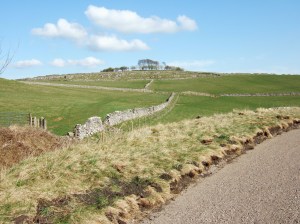
The uncovered (and presumably robbed many years ago) chambered tombs can be clearly made out. The views all round are truly magnificent.
Besides these chambered tombs for collective burial, many smaller barrows were erected over cavities cut out of the rock or built of limestone slabs as at Hob’s House, Monsal Dale. These served as burial-places for individuals, the body being interred in a crouched position.
The evidence of hand-made pottery of a kind called the Peterborough type shows that another branch of the Neolithic culture had come into the Peak District from the east. Fragments of such pottery have been found in places as far into the interior as the High Wheeldon Cave near Earl Sterndale and in a barrow near Arbor Low. Thus, considering all the relics so far brought to light, it would seem that the limestone country in particular was relatively well settled by Neolithic man. There are also traces of a system of trackways by means of which the exchange of products took place from one area to another. Yet on the higher northern moors some Mesolithic hunting communities lingered on almost unaffected by the material advances taking place to the south.
Between 2000 and 1500BC, the Bronze Age culture entered the district from the east. Physically they were of medium height with relatively broad skulls. In their tombs, however, long-headed types occur in sufficient numbers to indicate that the new arrivals and old inhabitants settled peaceably together. The burial customs altered, for chambered tombs were no longer used. With the body were placed drinking vessels or beakers. Later these were replaced by food vessels of coarser workmanship. This change serves to distinguish two phases of the eary Bronze Age culture, those of the Beaker people and Food Vessel people respectively. Over the burial place a mound of earth was heaped, forming a round barrow. Of the round barrows which have yielded beakers, well over twenty are located on the limestone country, whereas they have proved rare on the gritstone moors.
The Food Vessel people were probably the first to use bronze implements, for numerous examples of food vessels have been found along with polished flint axes and bronze weapons. Since nearly all the bronze objects are known to be of Irish origin there must have been considerable trade with the inhabitants of the Low Peak in particular. It is evident that some of the tribal chiefs were wealthy enough to provide their womenfolk with ornaments of Yorkshire jet. Though the pastoral economy continued, the cultivation of grain crops began, and the need for more land for this purpose is reflected in the use of heavy stone axes for removing part of the forest.
Towards 1000BC a fresh influx of Bronze Age people introduced the custom of cremation. In this case the ashes of the dead were placed in a small cist made of stones or covered with an urn turned upside down. Quite often they were placed inside the urn and covered with a stone. In any case the ashes were buried under a mound of earth. Sometimes these cinerary urns were deposited in clusters to form cemeteries. One of these cemeteries on Stanton Moor yielded fifteen urns. From this custom these newcomers are known as the Urn people. With superior weapons, including the spear, they appear to have subjugated the Food Vessel communities and gained control over much of the Peak District.
Stanton Moor is one of my most favourite spots in the Peak District. I like to walk up to and across it after having a decent meal and a couple of pints in the “Druid Inn” back down in Birchover. Apart from the Nine Ladies stone circle, there are dozens of other prehistoric finds to see, although many are hard to find and a detailed map is needed.
Besides settling in the limestone area, the Urn people penetrated the gritstone moors, where small stone circles or even solitary stones were erected. Examples of these are the Nine Ladies on Stanton Moor, mentioned above, the four remaining stones of the Nine Men on Harthill Moor, together with the stone circles on Froggatt Edge, Abney Moor, Moscar Moor and Ramsley Moor. These sites indicate not only an increase in population, which must have been accompanied by further forest clearing, but a substantial spread of settlement to the higher gritstone country.
The stone circle on Moscar Moor, sometimes referred to as the Hordron Edge circle is difficult to find in summer, when the surrounding vegetation is high. The views from here across to Win Hill and beyond, with Stanage Edge to the rear of the viewer are difficult to beat. I first walked to this stone circle in 1972.
The earliest phase of the Iron Age in Britain dates from the fifth century BC, but of the first people to enter from the Continent possessing a knowledge of iron, the Peak District bears hardly a trace. Only belatedly did the Bronze Age culture give way. One distinctive feature of the Iron Age, however, gradually appeared. This was the hill fort with its earth rampart and ditch generally constructed on the summit of a commanding hill. Examples are to be found on Mam Tor, Fin Cop, Ball Cross near Bakewell, and Combs Moss, south of Chapel-en-le-Frith, while on the south-east shoulder of Higgar Tor is the massive structure called Carl Wark. These forts are of varying date but were in use for a considerable period, some of them well into Roman times, As a rule they are smaller than those of Wessex, yet in their rather sombre surroundings they are equally impressive. Carl Wark, with its rampart faced with large gritstone blocks farming a wall nearly ten feet high, is probably of relatively late construction. It was long supposed to be of Celtic Iron Age date but is now regarded as post-Roman. By the time of the Roman invasion the older hill forts ceased to be of strategic value and were used only as refuges in local warfare or as shelters against cattle-raider.
Then came the Romans, and that is another subject.


Dr Philip Dodgson, Derby, January 2024
 DR PHILIP DODGSON of DERBY