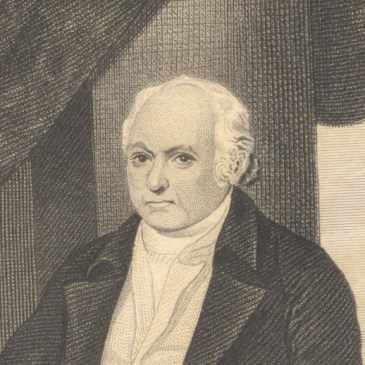
William Hutton (1723 – 1815) first came to my attention during a visit to the Roman Army Museum, which is located on or close to Hadrians Wall. This would be during the 1990s. We were doing a tour of Scotland and the Northern and Western Isles, and we visited this museum en route as it were. I cant remember all the details, but there was some sort of video exhibition about Hutton, detailing aspects of his life, including a walk he had done from his then home in Birmingham to Hadrians Wall, along the wall and then back home – a distance of 600 miles, all on foot and at the age of 78!
I have always been a keen walker and indeed had just completed a Land’s End to John o’Groats walk, walking 1202 miles over a largely scenic route, avoiding as many roads as possible. I therefore felt some sort of affinity with William Hutton, even though he had been dead for a long time, and I was only half his age when walking. My interest in him was consolidated by finding out that he had been born in Derby and had been apprenticed at the Silk Mill.
William Hutton was born at a house in Full Street, Derby in 1723. He had a troubled childhood to say the least, mostly because he was apprenticed at the nearby Silk Mill for 7 years between the ages of 7 and 14. Here he was regularly beaten by the overseers. Also his father was a heavy drinker, and this didn’t improve matters.
In 1737, Hutton moved on to a second apprenticeship, this time with his uncle in Nottingham, who was a stocking maker. The uncle died in 1746, and Hutton felt that he had to move on. What is really amazing at this point, is the huge distances Hutton walked just to try and seek his fortune – for example the 129 miles to London and back, done in only a few days. There were other prodigious feats of walking, done on a routine basis, and clearly not for fun, although the Hadrians Wall walk clearly was.
After opening a shop in Southwell for a short time, necessitating a 28 mile return walk once every Saturday from his then home in Nottingham, Hutton moved on to Birmingham, where he became a successful businessman, as well as a historian and poet. He still kept on walking though – more for fun now, as presumably he could by then afford a horse and carriage!
He was able to buy two houses in Birmingham, one was on the site of the Waterstones next to the Bull Ring (where I go to stock up with books from time to time). Both these houses were burnt down by mobs protesting against Dissenters – this was in 1791. Hutton was from a Dissenting family (being a Unitarian nonconformist). There was some connivance in these troubles from both king and prime minister. However, after many representations, Hutton received several thousand pounds in compensation – eventually.
Hutton wrote the following works:
- A History of Birmingham (1781)
- Journey to London(1784)
- Courts of requests(1787)
- Battle of Bosworth field(1788)
- History of Blackpool(1788)
- A dissertation on juries with a description of the Hundred Court(1788)
- History of the Hundred Courts(1790)
- History of Derby(1791)
- The Barbers, a poem(1793)
- Edgar and Elfrida, a poem(1793)
- The History of the Roman Wall(1802)
- Remarks upon North Wales(1803)
- Tour to Scarborough(1803)
- Poems, chiefly tales(1804)
- Trip to Coatham(1808)
- The Life of William Hutton, F.A.S.S. including a particular account of the riots of Birmingham in 1791, and the history of his family, written by himself, and published by his daughter, Catherine Hutton(1816)[1]
- The Life of William Hutton, Stationer, of Birmingham, and the history of his family, written by himself(1841) [2]
William Hutton died in 1815, age 91. He kept walking right to the very end.
From his book, “The Life of William Hutton”, I have selected the following paragraphs:
“I was born September 30 1723, which will bear the name of the last day in summer, on Wednesday, at a quarter before five in the evening, at the bottom of Full Street, in Derby; upon premises on the banks of the Derwent now occupied by Mr Upton, an Attorney”
“1725……….Memory now comes into use to aid the pen: for this year I recollect many incidents; one, playing upon the verge of the Derwent, with other children, where I am surprised they suffered a child of two to remain.”
“1731……….We were the only family of Dissenters connected with the mill. One of the clerks wished to make me a convert to the Establishment, and threw out the lure of a halfpenny every Sunday I went to church. This purchased me; and my father, being a moderate man, winked at the purchase. This proves an assertion of Sir Robert Walpole, ‘That every man has his price.’ However, none could be much lower than mine”
“1732……….Going to the execution of Hewitt and Rosamond (in Derby), I could not get over the steps at the brook ( presumably Markeaton Brook), and the crowd was more inclined to push me in than assist me. My father accidentally came, handed me over, and moralized upon the melancholy subject”
“1732……….Pouring some bobbins out of one box into another, the cogs of the engine caught the box in my hand. The works in all five rooms began to thunder, crack, and break into pieces; a universal cry of ‘Stop mills’ ensued. All the violent powers of nature operated within me. With the strength of a madman I wrenched the box from the wheel; but alas, the mischief was done. I durst not show my face, nor retreat to dinner till every soul was gone. Pity in distress was not found within those walls”
“1736……….I was now turned twelve, Life began to open. My situation at the mill was very unfavourable. Richard Porter, my master, had made a wound on my back with his cane. It grew worse. In a succeeding punishment, the point of his cane struck the wound, which gave exquisite pain, and brought it to a state that a mortification was apprehended. My father was advised to bathe me in Kedleston water. A cure was effected, and I yet carry the scar.”
“1737……….Christmas arrived, when I must quit that place, for which I had a sovereign contempt: which many hundreds had quitted during my stay; a place most curious and pleasing to the eye, but which gave me a seven years’ heartache”
And the following from “The History of Derby”
“THE STREETS……….Derby is said to be a mile long, that is from St. Mary’s Bridge to Cuckold’s Alley; but it must be a very short one. Neither is the passage straight, but curves with the river. Its breadth, from the top of Friar Gate, through Sadler Gate to the Derwent, is nearly half one. Could the town be thrown into a square, it would not cover one hundred acres. The Market Place is not large, but very neat, useful, and elegant, and is the first ornament of the place. There are about eighteen streets, but not more than six of these are central, as Queen Street, St. Mary’s Gate, Sadler Gate, Iron Gate, Rotten Row and Corn Markey; the others all verge upon the borders………The number of houses in Derby are said to be 1637, and the inhabitants 8563”
“There is also one amusement of the amphibious kind which, if not peculiar to Derby, is pursued with an avidity I have not observed elsewhere, football……….I have seen this coarse sport carried to the barbarous height of an election contest; nay, I have known a football hero chaired through the streets like a successful member, although his utmost elevation of character was no more than that of a butcher’s apprentice. Black eyes, bruised arms, and broken shins are equally the marks of victory and defeat……….as Derby is fenced in with rivers, it (the ball) seldom flies far without flying into the water, and I have seen the amphibious practitioners of football-kicking jump into the river upon a Shrove Tuesday, when the ground was covered with snow.”
Dr Philip Dodgson, Derby, January 2025
 DR PHILIP DODGSON of DERBY